March, 2010

Men’s Jeans Sloper and Pattern

I decided I wanted to start from scratch and make my own jeans pattern after not being completely happy with the results of the Burda 7733. I’ve also realized that this hobby is not just about sewing for me, but rather the entire process of making a garment from start to finish. That process includes designing/drafting my own patterns, picking out the fabric, sourcing notions, etc., and then the sewing. While sewing is obviously important and fun, it is only one of many steps involved in the process of creating a garment…and I want to do it ALL!

I didn’t really know anything about pattern making, but after scouring the internet for resources, I eventually settled on a book called The Practical Guide to Patternmaking for Fashion Designers: Menswear by Lori A. Knowles. It is a great resource for anyone wanting to make menswear, and was essential for helping me to make my own jeans pattern.

The first step in the pattern making process was using measurements taken directly from my body to draft a lower body sloper. I learned that a sloper is a very basic pattern, without any pockets or details, that provides a general shape and starting point for creating more “stylized” and finished patterns. From the sloper, you can draft actual pattern peices creating any style you want. It is a building block of sorts that can be used over and over.

mens jeans sloper 1

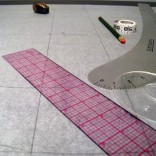
I needed an assortment of curves and rulers to draft the lower body sloper. It felt like a geometry project from high school at first.

mens jeans sloper 2

Here is the finished sloper pattern before I cut it out. I had to tape it to a glass door to be able to see the lines. The lower body back is on the left side, and the lower body front is on the right. From here, I cut out the front and back pieces in muslin for a test fit.

As I mentioned above, the jeans sloper has no pockets, yoke, or any details. It is just the fronts and backs sewn together to make sure I took proper measurements and that the basic shape and fit is correct.

My sloper fit great and I didn’t need to modify it to begin creating the jeans pattern. The book gives instructions for turning the sloper into a pattern, showing where to modify specific points on the sloper to create individual pattern pieces including pockets, yoke, waistband, fly, etc. I used these instructions as a starting point, but completely altered the shape and measurements to suit the style I was looking for. I wanted a somewhat slim fitting, straight leg, five pocket jean. The “straight leg” version in the book seemed more like a tapered leg to me so I changed the shape of the leg. I also changed the shape of the yoke, back pockets, front pockets, position of the crotch point, and the fly, arriving at my final pattern. The pattern in the book called for a zipper fly, but I decided that I was going to learn how to construct a button fly instead.

Once all of the pattern pieces were complete, I had to add seam allowance to all of the individual pieces. I used 3/4″ seam allowance for any areas where I would be doing a flat-felled seam, and 5/8″ everywhere else. These allowances are probably a bit big for muslin, but when I start using real denim, I want the flexibility to work with a bigger allowance.

I drafted all of the pattern pieces in tracing paper. Here is a picture of my final pattern. At this point, I hadn’t finished the fly so those pieces are not shown.

mens jeans pattern

The next step is to cut out and sew this pattern in muslin to see if everything goes together properly, and to check the fit again. Pattern drafting was actually quite enjoyable. I feel like it is the perfect right and left  brain collaboration, using geometry/math to achieve something more creative.

First Muslin Pair of “Jeans”

I figured that the best way to learn how to make a pair jeans was to start with a commercial pattern. I chose Burda 7733 mainly because it was one of only two patterns that I could easily find, and it seemed to have a more “modern” cut than the other pattern I saw. After completing the pattern with muslin though, I realized that I probably would have liked the fit of the Kwik Sew 3504 better. I can’t really say, however, because in trying to figure out which size to cut (Burda uses European sizing) I ended up cutting the pattern in too small of a size for me to actually try on. I’m a fairly skinny guy, usually wearing a 30-32 inch waist, and this practice pair would have fit like a blood restricting skinny jean, if I could have gotten them on at all.

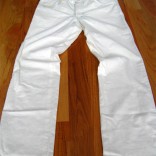
The pictures aren’t the greatest quality and the muslin definitely needs to be ironed, but you get the idea.

It seems like the back pockets are positioned a little too low.

After examining lots of pictures online, and studying a few pairs of jeans in my closet, I decided that there is a lot I would change about this pattern. Starting with the back pockets, I would alter the shape and placement. As I mentioned above, I couldn’t actually try these on, but judging from the picture on the pattern envelope, the back pockets fall below the butt area onto the hamstring, which is too low for my taste.

As far as the front pockets go, I’ve never seen front pockets constructed with the same method this pattern uses. Even with my limited sewing knowledge, I think there are better/cleaner ways to make front pockets that will be stronger and more durable.

The last major change I would make is to the fly. I’ve decided that I want to try and learn how to make a button fly rather than a zipper. I went ahead and put in the zipper fly here because that is what the pattern called for, but my next practice pair will have a button fly.

Depending on how you like your jeans to fit and look, this pattern might be just what you are looking for. For me, it was a great way to get some much needed sewing practice, and it helped me to figure out what I want to do with future pairs of jeans.